
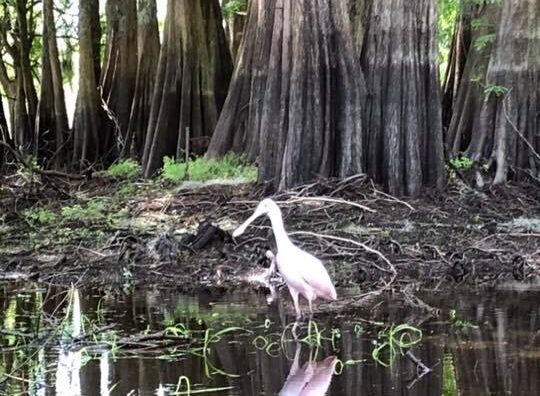
Because of the distance, I knew our journey today to Penny Wah Swamp, up and back would be a challenge. We paddled through the south end of Lake Winder into the south river channel, where as usual no less than fifty gators of all sizes greet us. From here it’s another 3 miles to an unremarkable slough, with two obscure tributaries far to the west into Penny Wah. With lower water levels then expected one of the tributaries is unpassable. The other one gets us into the furthest eastern section of this primordial, haunting swamp. Paddling through these silent waters I feel like I’m back in time with the Ais Indians, bows drawn as we invade their precious haunts. Two red-tail hawks scream their displeasure as we near their nest high into the canopy. A piliated woodpecker drumming far in the distance. We paddle back as far as we can before our kayaks become grounded. From here we hike the ancient riverbed of Penny Wah Creek. The cypress standing straight and tall like sentries, unsure as they should be, of our intent. Gone are the three-thousand-year-old virgin stands of cypress that stood against the world for millennia, but couldn’t stand against man and steel, our audacity and recklessness. Curious that George Hobkins and his lumber crews, a hundred years ago didn’t seem to log here, in that there are no stumps to be found. Hobkin’s railroad, “The Union Cypress Railroad” that took the trees to his sawmill in South Melbourne was far to the west of our location. The trees here in Penny Wah and Wolf Creek, three miles further north may have been to far east and too small to bother. Many of the cypress here are 3-5 feet in diameter. It typically takes 350-400 years to reach a diameter of 3 feet and perhaps 800-1000 years to reach 6-7 feet. Although we didn’t make it into the heart of Penny Wah and I am not a religious man but if there is a God, she lives here.
With Ernie Green.