
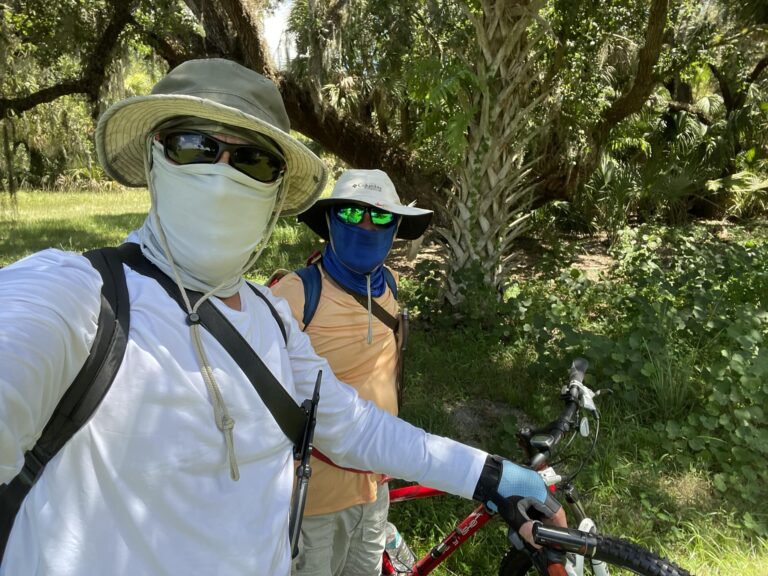
Our trip today on the St. John’s is to bike from Moccasin Track (South) on an old jeep corridor than off road to the St. John’s River Marsh, 3> miles.
From here we’ll hike another hard 1> mile down a dry tributary to the river between Lake Washington and Lake Winder.
With the Summer season and little rain, other than a couple of gator holes and a large shallow depression
there is little to no water. Dry or wet this vast fresh water marsh still flourishes. The Crimson eyed Rose Mallow in vast fields sways to the whim of the wind.
Resistant to almost all pests and disease the Rose Mallow thrives here.
Other marsh plants include Bull Rush, Sand Cord Grass, Switch Grass, Giant Maiden Cane and Coastal Plain Willow along the river banks.
In the middle of the day with 105 heat index wildlife is scarce.
There’s a couple of tri-colored herons a green heron and two young moor hens at the first gator hole. Around the gator hole is wet and spongy
as you have to watch where you put your weight. Suddenly I find myself crashing thru the dishonest crust as I’m almost up to my waist in the thick sucking peat.
In such a maze of daunting beauty, that is the St. John’s Marsh, it’s not easy to follow the dry tributary that is covered over in this bountiful flora.
As a guide you have to be able to read the land as well as the river. From the second gator hole the channel totally vanishes, awash in a sea of green.
Looking out ahead toward the 12’ Giant Maiden Cane, which sporadically covers the marsh in thick impassable rows
I spot an obscure break in the cane and sure enough that’s the channel/animal trail.
With an active trail for Hogs, Deer and other animals including Gators during the wet months the cane grass here can never take root, so the passage stays open.
After a long hard hike thru this amazing fresh water marsh, we make it down to the river. With camp sites nearly nonexistent on the upper St. John’s
the purpose of this trip is to find an alternative kayak route off the river to an upland area. With good water this is a viable option for a camp site or for an emergency.
With my good friend Ernie Green.
Addendum:
If a fire starts in a bone-dry marsh, which the marsh here was not, it’s easy to understand why so many deaths were recorded from the pioneering families
who farmed, ranched, trapped and hunted this land. Unless you’re as fast as the wind it’s almost impossible to outrun a marsh fire.
Trying to run any distance crashing thru hip deep dry litter is nearly impossible.
Mark Nathan
321-543-0373