
Where: Salt Lake area
When: December 14th and 15th
Weather: Monday -mostly cloudy misty rain
Weather: Tuesday – mostly sunny
Wind: Slight West
Temp: 56 -72 degrees
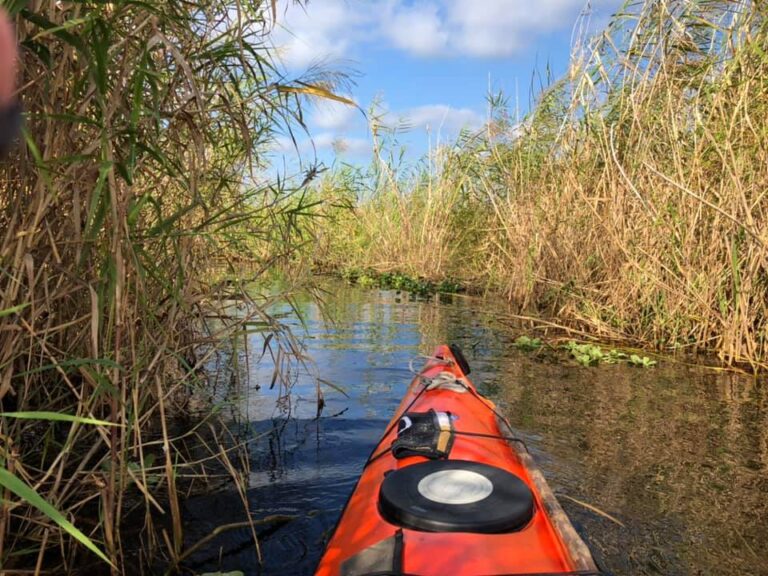
The latest trip on the St. John’s from the Hatbill takes us thru Ruth Lake into Clark Lake. From there we take a side trip to paddle a channel into remote Silver Lake. Then back out, into Clark and thru a winding narrow mile long passage into Loughman Lake. There islands of bullrush and maiden cane sing in the wind as we paddle thru the heart. The dense Cord grass along the shoreline turns from a dark green to a wheat hue under the late Autumn sun. Finally, after 2 miles we find the elusive river channel, with its many confusing tributaries that will lead us into Salt Lake. The purpose of the journey, other than the beauty of it all, is to locate Shad creek and map out the many confusing and hidden passages that is Salt Lake. Lying deep beneath these marshes, pockets of prehistoric salt water bubble up as salt springs. As a result, the salinity of South Lake, Loughman and Salt Lake has a salinity of nearly one third that of the Ocean. This enables salt loving plants, marine crustaceans and salt loving fish to live in what is a fresh water river. Every year beginning in mid-December till early March the St. John’s comes alive with Shad as they migrate on their long journey from the Ocean to spawn in these waters, much the same as Salmon.
After an amazing day exploring, the shadows are casting long, the sun low, as we finally find a small palm hammock on the South end of Salt Lake that is dry enough to camp. We pull our kayaks some 30 feet thru the thick cord grass in ankle deep water. The next day we wake to a clear sky after a windy cold night. The morning fire always a comfort. We spend the next morning and afternoon exploring some of the channels, sloughs and unnamed hidden lakes, on the North side. As always uniquely secluded.
Footnote: The White pelicans arrive on the St john’s in late Fall, from the Central Plains and Canada. The area from Lake Harney, North, to Fort Christmas, South support some 500 to 600 hundred of these huge birds. Whether we just didn’t see them or it’s just too early, we saw none.
With my friend Ernie Green.