As a long time, kayak guide explorer and historian on the
Upper St Johns River I cannot think of a place I hold in such
regard as the Lake Winder area. The St Johns called Illika
by the Native Indians the French; Rivere De Mai
the Spanish; San Mateo and the San Juan
and by the English; the St Johns.
What sets the Upper St Johns apart is its serene remoteness
and native beauty. From its headwaters at Halpaliokee Swamp
to Fort Drum, to the start of navigation at Blue Cypress to Lake Harney.
This 130-mile river wilderness corridor is like no other.
Surrounded by hundreds of thousands of acres of native
fauna and flora the St Johns floodplain can be up to 7 miles across.
Off the main channels there are hundreds of miles of twisting
confusing tributaries and hidden sloughs accessible by paddle boats only.
From the St Johns impenetrable marshes, the bottomlands
of its hidden swamps of hardwood forests of Bald Cypress and Sweet Gum.
The vast prairies to the upland Piney Flatwoods to the Native
Florida Hammocks of Live Oaks, Sable Palms, Holly, Magnolia, Elm and Bay.
Because of the river’s vast floodplain, other than the bridge heads
there are no roads or trails leading to the river.
In a kayak you can be a long day away to the next access point.
No houses or docks no campsites, fire rings or facilities.
Nary a trace of man. You are on your own. Because of sandbars and the many shallows,
boats cannot access most of these pristine waters.
This wilderness river corridor is one of the last in Florida
where you can be totally alone for days.
We should all do all we can to save what’s left
of these unique river wilderness areas.
What makes lake Winder so special is its early history.
Before the 192 bridge spanned the river in 1925
the only places to cross the St Johns floodplain
for cattle and people was a natural sandbar
on the South end of Lake Winder or 50 miles
North at Enterprise on Lake Monroe.
Because of the natural crossing at Winder
where The South river comes into the lake
a trading post of sorts was used by the
indigenous natives, the Tuscana and Ais
going back thousands of years.
Later white settlers and the Seminoles also traded there.
In 1838 Fort Taylor was the first structure built
near the ford during the 2ed Seminole War (1835-1842).
A Lieutenant Wick built a lookout on a large Indian Midden
adjutant the fort that’s still there today.
In 1850 RL Savage built a trading post in that same area.
Soon a small community was built around the lake called Savage.
In 1879 the Charles Willey was the first paddle boat
to make it to the Savage trading post with goods.
In 1899 a Post Office was established
and in 1904 was discontinued.
The trading post came to an end in 1915 with Henry Savage
being the only family member still living.
Soon after the lake was abandoned.
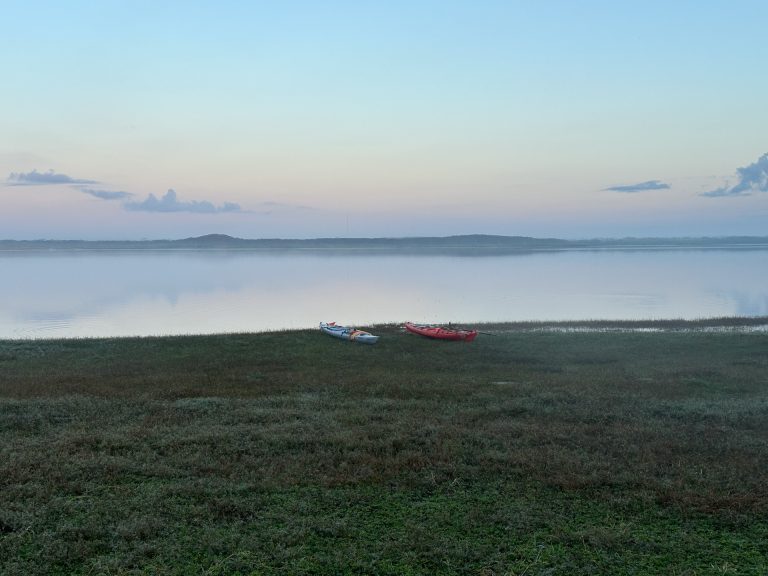
Looking across Lake Winder from Moccasin Island
trying to imagine all the souls
that were here all those years before.
Reflections of who they were their trials and tribulations
and how I fit in today.
Waking up to a thick fog
I feel privileged just being here.
With my good friend Jim Durocher.
Mark Nathan
St Johns Explorer